The global container shipping market is splitting in two. While US-bound freight rates have surged for eight consecutive weeks—with the US East Coast breaking $10,000 per FEU and year-on-year increases reaching 201%—Europe and Mediterranean lanes continue to soften. This is not a uniform market rally. It is a structural divergence that is reshaping procurement strategies, inventory planning, and cost expectations for importers on both sides of the Atlantic.
1. The Data: US Rates Climb for an Eighth Straight Week
The Shanghai Containerized Freight Index (SCFI) rose again in the week ending September 18, 2026, marking its eighth consecutive weekly gain. The headline index reached 3,687.83 points, up 178.29 points or 5.08% week-on-week.
The divergence between US and European lanes is stark:
| Route |
Rate |
Weekly Change |
Year-on-Year Change |
| US East Coast (FEU) |
$10,479 |
+3.0% |
+201% |
| US West Coast (FEU) |
$7,712 |
+2.0% |
— |
| North Europe (TEU) |
~$2,600 |
Flat to slightly down |
— |
| Mediterranean (TEU) |
~$3,400 |
Slightly down |
— |
The US East Coast rate has now broken through the $10,000 mark for the second time this year, after briefly touching that level in late August. The US West Coast rate, at $7,712 per FEU, is also at its highest level since the pandemic-era peak.
Bank of America retail analysts have flagged the scale of the increase: ocean freight costs on US-bound routes are now up 201% year-on-year, approaching the 250% peak surge recorded during the 2021 container shortage crisis. For retailers, this represents a direct hit to landed costs at a time when consumer demand remains resilient but price sensitivity is high.
2. The Drivers: Three Forces Converging on US-Bound Capacity
The surge is not driven by a uniform increase in global demand. Instead, three specific forces are squeezing capacity on transpacific routes.
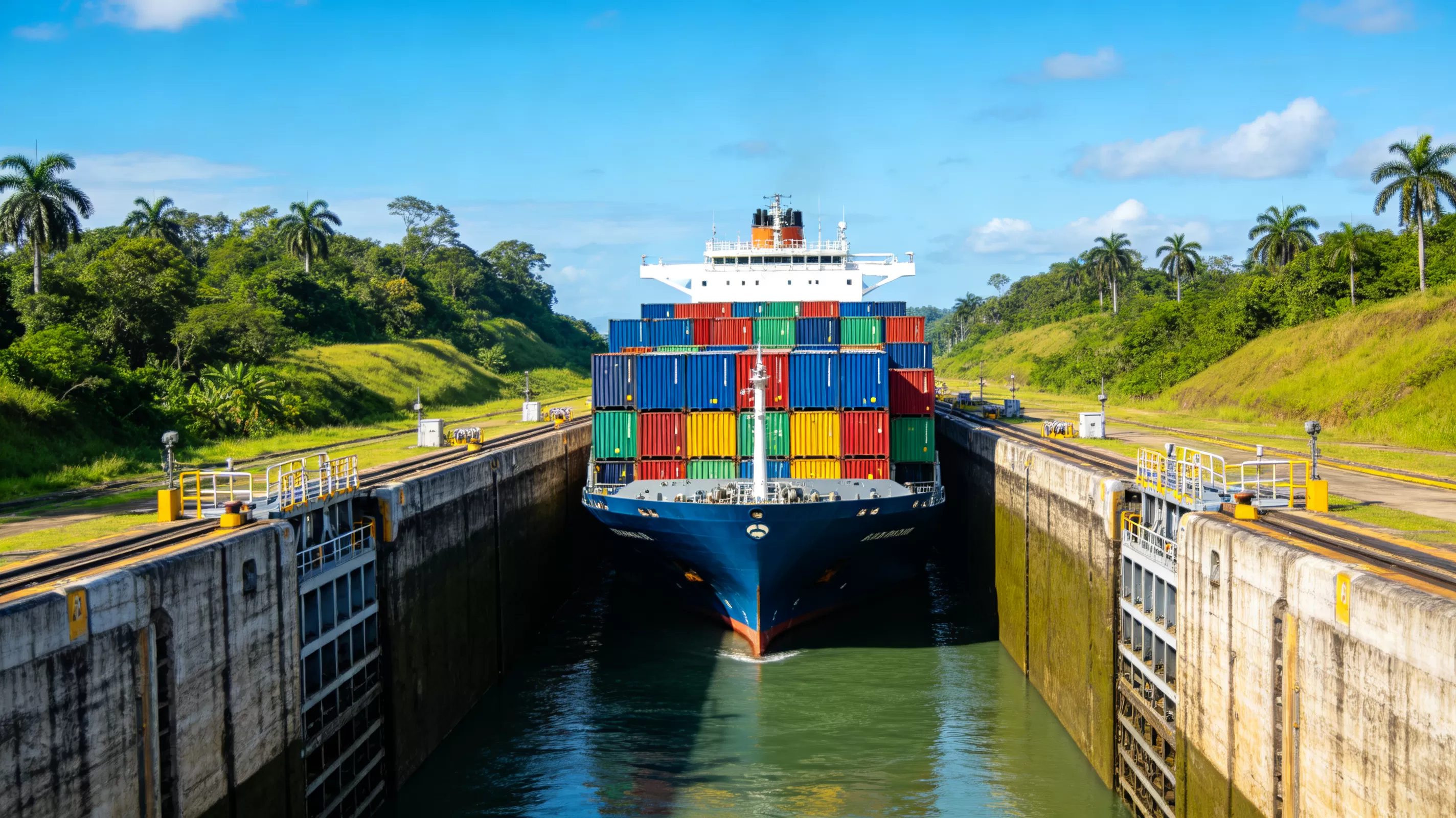
First, the Panama Canal drought continues to bite. The Panama Canal Authority has reduced daily transit slots to 32 vessels and lowered maximum drafts to 14.78 metres. For every 15-centimetre reduction in draft, large container vessels must leave behind several hundred TEUs. The canal’s capacity constraints directly affect US East Coast services, which depend on the waterway for roughly 40% of their volume. Carriers have responded with surcharges: MSC has imposed a $149 per TEU and $297 per FEU Panama Canal surcharge, while CMA CGM has introduced a $500 per TEU “Panama Canal Adjustment Factor” on Far East to US East Coast cargo.
Second, Red Sea diversions continue to absorb global capacity. Most container vessels are still routing around the Cape of Good Hope rather than transiting the Suez Canal. This adds 10–14 days to Asia-Europe voyages and ties up vessels for longer periods, reducing the effective global fleet. The result is a “hidden” capacity crunch that affects all routes, but is felt most acutely on the longer transpacific lanes.
Third, a pre-holiday shipping rush is colliding with typhoon-related backlogs. Chinese exporters have been front-loading shipments ahead of the October Golden Week holiday, when factories and ports slow down. At the same time, a succession of typhoons—Bavi, Noul, Dolphin, Narra, and Saudel—has disrupted port operations in Shanghai, Ningbo, and other major Chinese gateways. Vessels are now waiting up to 10 days to berth at Shanghai and Ningbo, and the backlog is only slowly clearing. The combination of holiday front-loading and weather-related delays has created a concentrated surge in bookings just as capacity is already tight.
3. The Divergence: Why Europe Is Not Sharing the Pain
While US-bound rates have surged, Europe and Mediterranean lanes have remained soft. The SCFI’s Europe sub-index has fallen for eight consecutive weeks, and Mediterranean rates have followed a similar path.
The reasons for this divergence are structural:
-
Demand patterns differ. US importers are restocking ahead of the holiday season and hedging against potential tariff changes. European importers, by contrast, are still working through inventory and face weaker consumer confidence.
-
Capacity deployment is skewed. Carriers are prioritising US-bound services because they offer higher yields. This leaves relatively more capacity available for Europe-bound cargo, keeping rates down.
-
The EU’s new tariff regime is dampening e-commerce volumes. Since July 1, the EU has eliminated the €150 duty exemption and imposed a €3 per-item customs duty on low-value parcels. This has reduced the volume of low-value e-commerce cargo moving from China to Europe, freeing up some capacity on those lanes.
The result is a two-speed market: US-bound shippers face rising costs and tight space, while Europe-bound shippers benefit from softer rates and relatively more available capacity.
4. The Transmission Effect: How Higher Freight Rates Reach Consumers
The 201% year-on-year increase in US-bound freight rates is not just a logistics problem—it is an inflationary input that will eventually reach consumers.
Bank of America analysts estimate that every 10% increase in ocean freight rates translates into a 0.1% to 0.2% increase in core goods prices. At current levels, the freight surge could add 0.2% to 0.4% to US consumer price inflation if sustained.
For retailers, the immediate challenge is margin management. Many have locked in long-term contracts at lower rates, but spot market exposure is rising. As contracts expire, retailers will face higher renewal rates, and those costs will either be absorbed (hurting margins) or passed on to consumers (fuelling inflation).
The inventory planning challenge is equally significant. With transit times longer and space harder to secure, retailers must plan further ahead. Some are shifting to a “just-in-case” model, holding more safety stock to avoid stockouts during the holiday season. Others are diversifying their sourcing to include more suppliers from the Western Hemisphere, reducing exposure to transpacific shipping.
5. What This Means for Shippers
The current market environment demands a more strategic approach to ocean freight procurement.
For US-bound shippers:
-
Book space early. With load factors high and capacity tight, waiting until the last minute will result in significantly higher costs or no space at all. Book at least 3–4 weeks in advance for the rest of 2026.
-
Factor surcharges into your budget. Panama Canal surcharges, peak season surcharges, and general rate increases are stacking up. The $10,479 per FEU US East Coast rate does not include all these add-ons.
-
Consider alternative routings. For non-urgent cargo, routing via the US West Coast with onward rail transport to the East Coast may offer cost savings, though West Coast rates are also rising.
-
Evaluate contract vs. spot exposure. With carriers prioritising spot cargo, long-term contract space is harder to secure. Consider paying a premium for guaranteed capacity if your supply chain depends on it.
For Europe-bound shippers:
-
Take advantage of softer rates. Europe and Mediterranean lanes are currently the softest major routes. If you have flexibility, consider negotiating favourable long-term contracts while rates are low.
-
Monitor the EU’s new tariff regime. The €3 per-item duty on low-value parcels is reshaping e-commerce logistics. If you ship to Europe, ensure your customs declarations and duty calculations are accurate.
-
Watch for capacity shifts. If US-bound demand remains strong, carriers may continue to prioritise transpacific services, leaving Europe-bound capacity relatively abundant. This could keep Europe rates soft into 2027.
For all shippers:
-
Build flexibility into your logistics planning. The divergence between US and Europe lanes is a reminder that global shipping markets are not monolithic. A single procurement strategy will not work across all routes.
-
Monitor the Panama Canal and Red Sea situations. Both are outside the control of carriers and shippers, but both have a direct impact on capacity and rates. A change in either could shift the market within weeks.
Glovoyce Observation
The 201% year-on-year surge in US-bound freight rates is not a temporary spike. It is the result of a structural capacity squeeze driven by drought, conflict, and weather. While Europe-bound shippers enjoy softer rates today, the global fleet is being stretched in ways that could eventually affect all routes.
The key insight for importers is that route-specific strategy matters more than ever. US-bound shippers need to secure capacity early, budget for surcharges, and build alternative routings into their plans. Europe-bound shippers should lock in favourable rates while they can, but remain alert to the possibility that capacity could shift if US demand continues to absorb the global fleet.
In a two-speed market, the winners will be those who understand the drivers—and plan accordingly.
This article is based on data from the Shanghai Shipping Exchange, Bank of America, Linerlytica, and industry sources as of September 23, 2026. For specific procurement advice, please consult your Glovoyce account manager.