Effective September 18, 2026, U.S. Customs and Border Protection (CBP) begins enhanced enforcement of Importer of Record (IOR) data accuracy on Form 5106. Inaccurate, incomplete, or outdated information can trigger immediate voiding of an IOR number—rendering it invalid for any purpose, including entering goods into the United States. With no grace period and no advance warning, shipments may stop at the port without notice. This article explains what CBP is verifying, which long-accepted industry practices are now compliance defects, and the corrective steps importers must take immediately.
1. What Is Happening and Why It Matters Today
On August 19, 2026, CBP published a general notice in the Federal Register announcing enhanced enforcement procedures to verify the accuracy of information submitted on Form 5106, the Create/Update Importer Identity Form. The enforcement measures—implemented pursuant to Executive Order 14411, "Strengthening Customs Enforcement"—take effect exactly 30 days after publication: September 18, 2026.
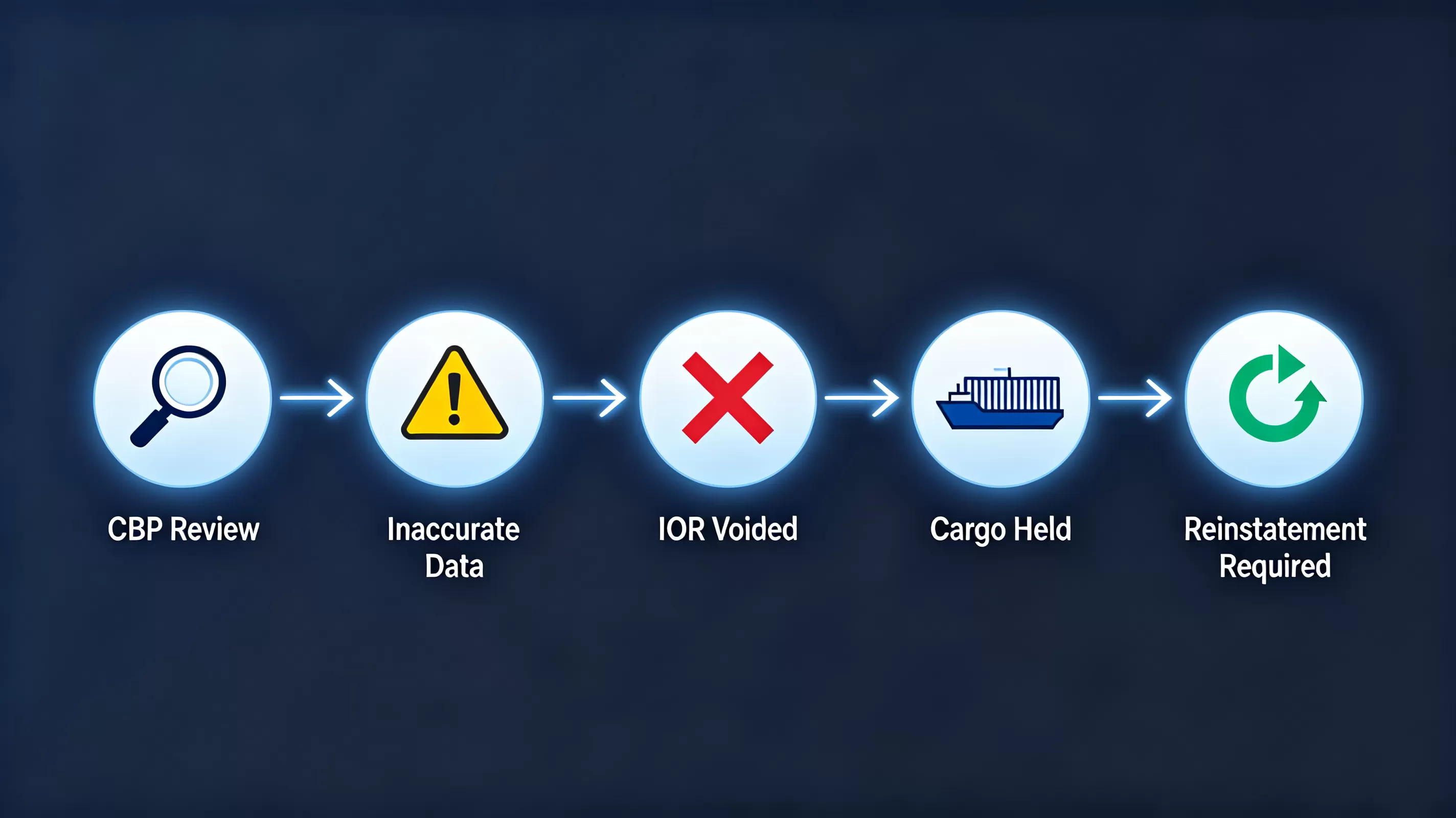
Starting today, if CBP determines that an IOR's information is inaccurate or incomplete, it will immediately void the IOR number. A voided IOR number is invalid for every purpose, including making entry. In practical terms, this means cargo stops at the port with no advance warning.
CBP has stated that its review is comprehensive, covering both new and existing importers of record. The agency is not offering extended grace periods or leniency for outdated information or clerical errors.
Critical detail: The voiding notice will be sent to the email address most recently provided on the IOR's Form 5106. If that email address is incorrect or belongs to a third party, the importer may not learn of the voiding until cargo stops moving.
2. What CBP Is Verifying: The Six Data Elements
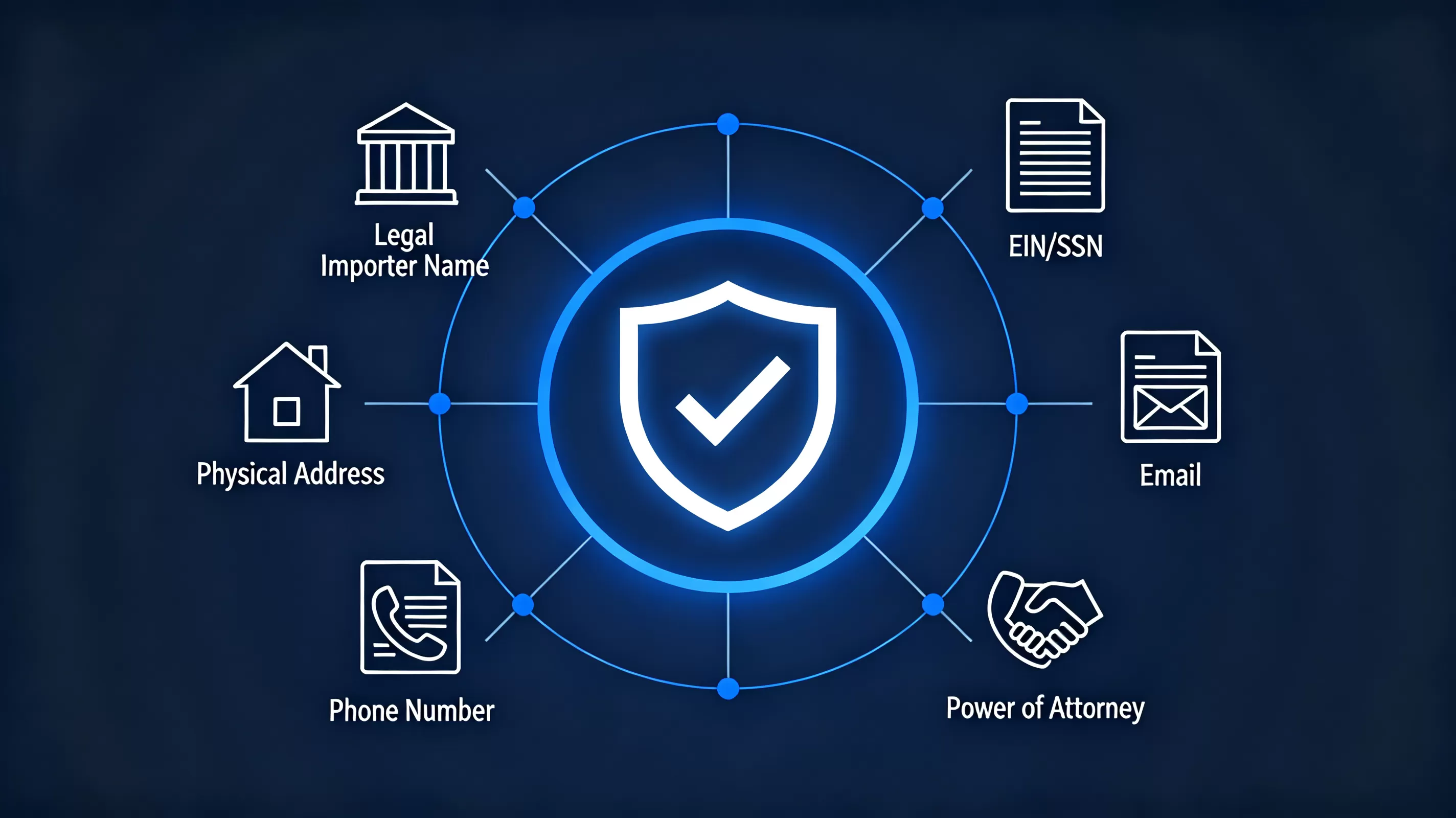
CBP's review focuses on six core data elements on Form 5106. Each must be accurate, complete, and belong directly to the IOR—not to a broker, freight forwarder, or any other third party.
| Data Element |
Requirement |
Common Compliance Defect |
| Legal Importer Name |
Must match the entity on file with the IRS or CBP |
Trade name used instead of legal entity name |
| EIN / SSN / CBP Number |
Must belong directly to the IOR |
Number belongs to a related entity or intermediary |
| Mailing Address |
Must be the IOR's actual mailing location |
Broker or forwarder address used |
| Physical Address |
Must be the IOR's actual business or individual location. P.O. boxes, registered agent addresses, customs broker addresses, freight forwarder addresses, business service centers, and third-party addresses are NOT acceptable |
Broker/forwarder address, virtual office, or P.O. box listed |
| Email Address |
Must be valid and belong to the IOR |
Broker or third-party email address substituted |
| Phone Number |
Must be valid and belong to the IOR |
Broker or third-party number substituted |
Power of Attorney requirement: Customs brokers submitting Form 5106 on behalf of an importer must hold a valid Power of Attorney executed directly with the IOR—not routed through a freight forwarder or other intermediary. A broker relying on a third-party intermediary for POA authority is now non-compliant.
For individual importers: A home address is acceptable if it is genuinely the individual's actual physical location.
3. The Compliance Landscape: What Has Changed
The enforcement of Form 5106 accuracy is the first concrete implementation step of Executive Order 14411, signed on June 3, 2026. The EO directed the Department of Homeland Security to confirm that active IORs comply with applicable regulations and disclosure requirements.
A structural shift from data collection to data enforcement
CBP is moving from passively collecting IOR data to actively verifying and enforcing it. The agency is "comprehensively reviewing" the Form 5106 information on file for all importers of record. This is not a targeted audit—it is a systematic verification exercise.
Why this matters for cross-border e-commerce
The enforcement targets a long-standing industry practice: the use of "borrowed" or "virtual" IOR numbers. Under the old system, many small and medium-sized importers—particularly in cross-border e-commerce—relied on freight forwarders or customs brokers to provide IOR numbers, often with the broker's own address and contact information listed on Form 5106. This practice is now a compliance defect that can void the IOR number entirely.
Industry sources estimate that approximately 30% of IOR profiles for US-bound shipments from China may contain substantive defects—either the address is a freight forwarder's location, or the contact information belongs to a third party.
4. Consequences of Non-Compliance: More Than a Voided Number
The consequences extend well beyond the immediate voiding of an IOR number.
Immediate operational impact:
-
Cargo stops at the port with no advance warning
-
Shipments cannot be entered into the United States
-
Supply chains are disrupted without notice
Legal exposure:
-
Criminal penalties: Knowingly submitting false statements on Form 5106 can trigger penalties under 18 U.S.C. § 1001, including fines and imprisonment
-
False Claims Act liability: Because IOR data is material to the obligation to pay duties, inaccurate or misleading information could subject the IOR to liability under the False Claims Act
-
Broker penalties: Customs brokers submitting inaccurate or invalid information face penalties under 19 U.S.C. § 1641
Impact on refunds: A voided or invalid IOR number may also impact an importer's ability to receive refunds on CBP bills, including IEEPA tariff refunds.
5. The Reinstatement Process: What Happens If Your IOR Is Voided
If CBP voids an IOR number, it will issue a written notice to the email address most recently provided, explaining the reason for the action and the process for requesting reestablishment.
Reinstatement options:
-
ABI broker reactivation: An Automated Broker Interface broker can submit a Transaction Processing message with Action Code A to change the status from "20-Inactive" to "10-Active," provided all required Form 5106 data elements are submitted with the message-
-
Manual reactivation: Importers unable to reactivate via ABI may submit a revised Form 5106 with all mandatory data elements completed to a Center Entry Specialist Team-
-
Direct email: Questions and reinstatement requests can be sent to IORProgram@cbp.dhs.gov using the subject line "Enforcing IOR Accuracy"
Important: Correcting issues after a number has been voided may take time and could affect ongoing import operations. The time to verify and correct is now, not after a voiding notice is received.
6. Immediate Action Steps for Importers
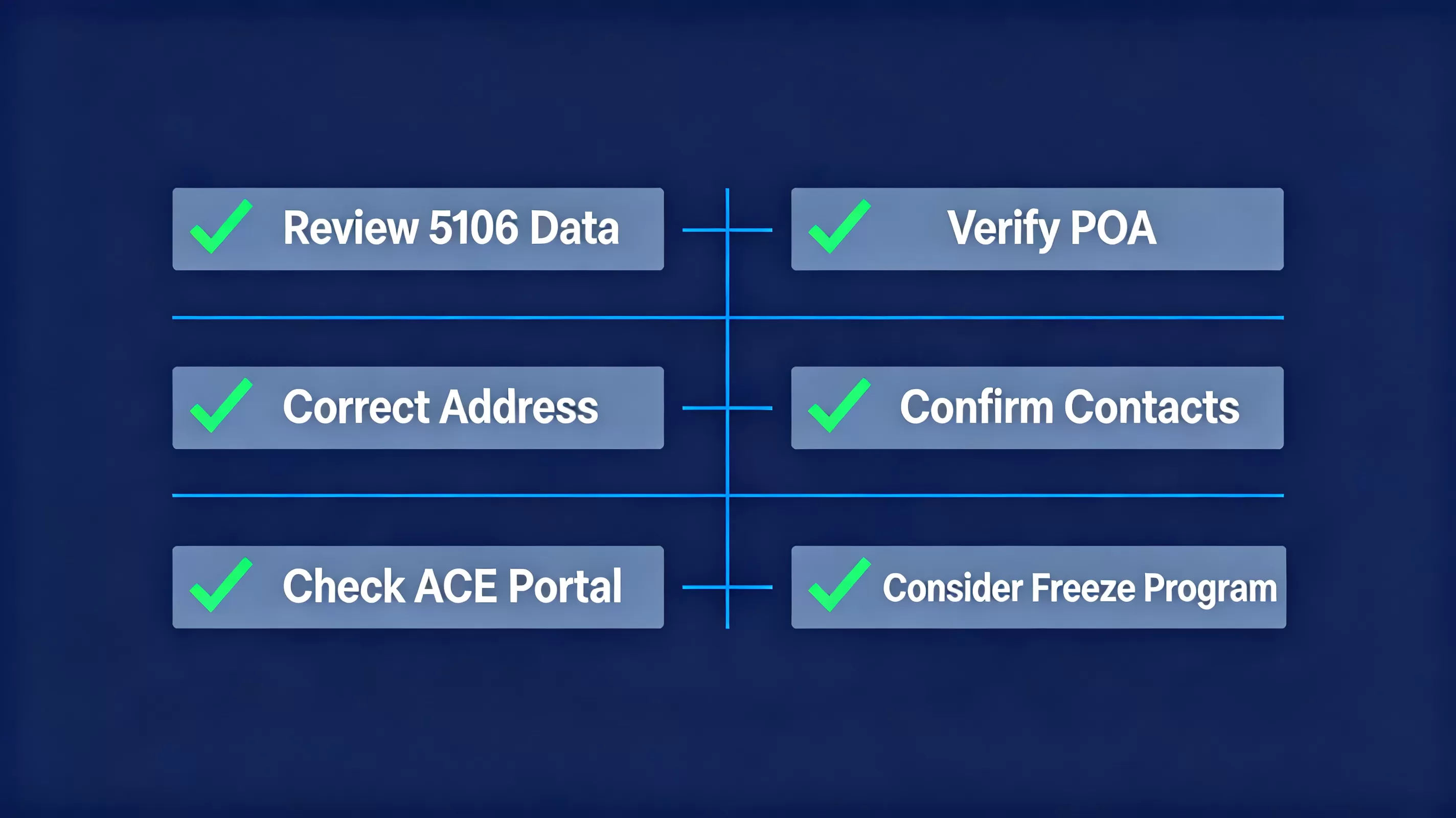
For importers with US-bound cargo, the following steps should be taken immediately:
Step 1: Review your Form 5106 data. Confirm that the physical address, email address, phone number, and EIN/SSN on file with CBP are current and belong directly to your company—not to a broker, forwarder, or service address.
Step 2: Verify your broker's Power of Attorney. Confirm that your customs broker holds a valid POA executed directly with your company and is not relying on a third-party intermediary.
Step 3: Correct any discrepancies. If your physical address is a P.O. box, registered agent address, broker address, freight forwarder address, or business service center, update it immediately to your actual business location.
Step 4: Confirm contact information. Ensure the email address and phone number on file belong to your company, not to a broker or third-party service provider.
Step 5: Check your ACE Portal account. Create or maintain an active ACE Portal account to review and update your IOR information directly.
Step 6: Consider the Importer Identity Freeze Program. CBP offers a program to protect importer information from unauthorized changes.
7. What This Means for Cross-Border E-Commerce
For cross-border e-commerce sellers using DDP (Delivered Duty Paid) arrangements or relying on freight forwarders to handle customs clearance, the enforcement of Form 5106 accuracy represents a fundamental shift.
The era of "borrowed" IOR numbers is over. Sellers who have been using a forwarder's or broker's IOR number—with the forwarder's address and contact information on file—now face the prospect of cargo being stopped at the port. There is no workaround: CBP requires the IOR's actual physical location and contact information on Form 5106-.
Options for sellers without a US entity:
-
Establish a US entity with a genuine physical presence and US-based personnel
-
Use a compliant, verified IOR service that provides a legitimate US business address and contact information belonging to the IOR
-
Shift to a DDP model with a compliant importer of record who can meet CBP's requirements
The enforcement of Form 5106 accuracy aligns with a broader trend: CBP is moving from a focus on "whether goods are compliant" to "whether the importing entity is compliant and accountable". This shift is not temporary—it is structural.
Glovoyce Observation
Today's enforcement of Form 5106 accuracy is not an isolated policy change. It is the operational implementation of Executive Order 14411, which explicitly frames customs enforcement as a matter of national security, foreign policy, and economic interest. The message from CBP is clear: importing into the United States is a privilege, not a right—and that privilege requires accurate, verifiable identification of the importer of record.
For importers, the immediate priority is compliance verification. A voided IOR number is not a temporary inconvenience—it is a complete halt to US import operations until reinstatement is granted. And reinstatement is neither automatic nor instantaneous.
The longer-term implication is equally significant. CBP's enforcement of Form 5106 accuracy is the first step in a broader reform of importer eligibility. Executive Order 14411 also directs CBP to revise regulations requiring IORs to maintain minimum levels of tangible domestic assets or bonding, and to provide additional data including beneficial ownership disclosures and supply chain information. Importers who establish compliant structures now will be better positioned as these further requirements are implemented.
For cross-border sellers who have relied on informal or "borrowed" IOR arrangements, the path forward requires a genuine importer of record with a real US presence. Glovoyce can assist with compliant IOR solutions, customs brokerage coordination, and supply chain structuring to ensure your US-bound cargo continues to move without interruption.